
Olympia Chimney Chimney Sweep in Louisville: A Homeowner’s Guide
An Olympia stainless steel chimney cap will outlast a galvanized one by a decade in Louisville’s freeze-thaw winters, but only if the mesh gauge matches the clearance requirements for your appliance type – and the box won’t tell you that. Olympia Chimney Supply makes solid venting and chimney components, and we install their caps, liners, dampers, and chase covers regularly around Louisville. The trouble is that buying the right part for the wrong application is a common and expensive mistake. This guide explains what Olympia actually makes, where it performs well, and what a proper installation involves.
If you’d rather not sort wall thickness and BTU ratings on your own, call (844) 560-6386. We answer 24/7. Fast dispatch from 7am to 7pm, Sunday through Friday.
What does Olympia Chimney Supply actually manufacture?
Olympia Chimney Supply manufactures four main product families: chimney caps, flexible stainless steel liners, top-mount dampers, and chase covers. That’s the core of it. Online listings often slap the Olympia name on unrelated hardware-store parts, generic mesh screens, and third-party vent boots that have nothing to do with the company. If you’re shopping for an Olympia component, look for the actual product line before you trust the label.
The four families break down like this:
- Caps – stainless steel and multi-flue styles, including mesh-screened designs for spark containment and animal exclusion.
- Flexible liners – stainless steel, sold in wall thicknesses that matter for appliance matching (more on that below).
- Top-mount dampers – a cable-operated damper that seals at the top of the flue rather than inside the firebox.
- Chase covers – the flat or multi-flue tops that close off an exterior chimney chase.
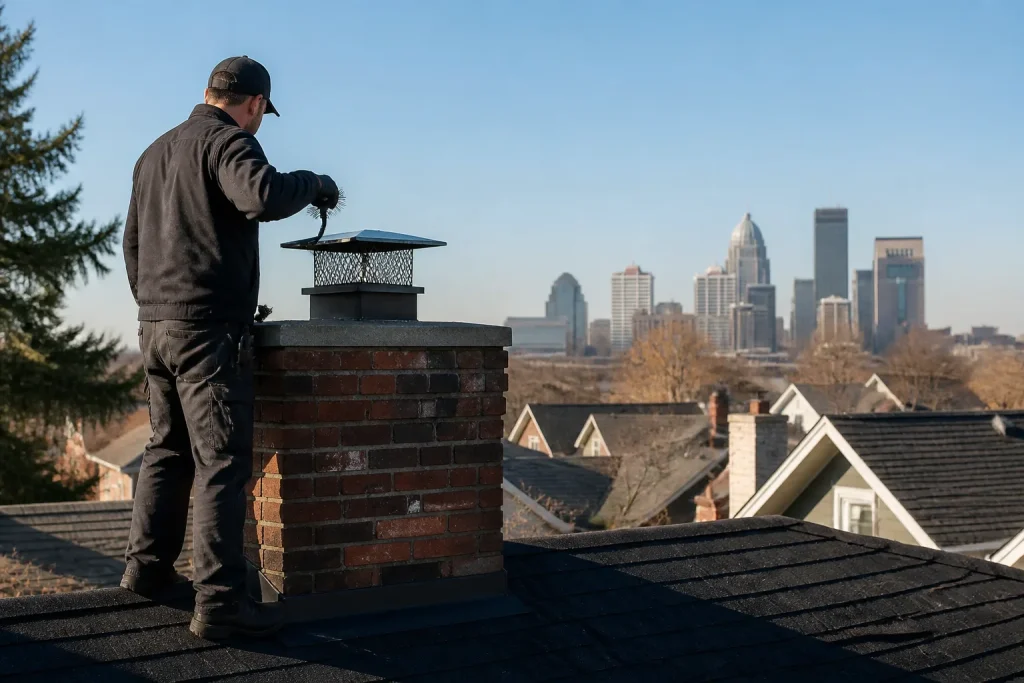
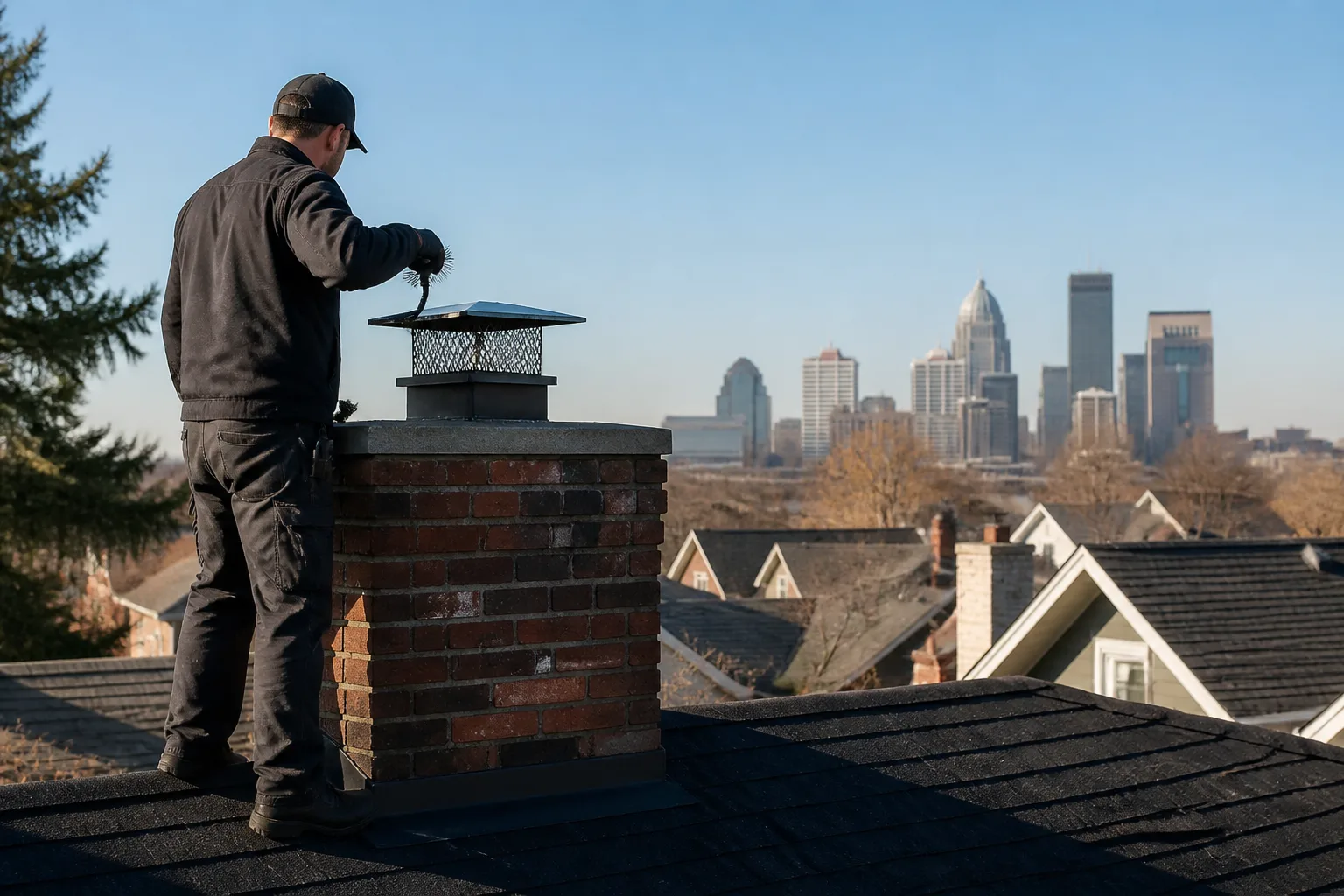
Louisville homes with exterior masonry chimneys take a beating from summer humidity and winter freeze-thaw. An Olympia stainless cap handles that climate far better than a galvanized one, which is exactly why the brand shows up so often on Louisville rooftops. The caveat is the same every time: the right brand of part is only half the job. The other half is specification.
How do you match an Olympia liner gauge to your appliance and flue?
Match the liner wall thickness to the appliance’s heat output and the length of the flue run. Olympia flexible stainless liners come in two common walls: 0.006-inch and 0.010-inch. A short flue serving a gas insert or a modern high-efficiency wood stove can often use the lighter 0.006 wall. Longer runs handle better with 0.010, and any solid-fuel appliance venting a hot fire needs the heavier wall to hold up over time.
Louisville’s typical two-story colonial stack height – often 25 to 35 feet from firebox to cap – is where this decision really matters. A long run of lighter-wall liner under continuous heat is more prone to kinking on the bends and to eventual failure at the joints. The heavier wall resists both. Neither number is printed on the retail box in language a homeowner can easily apply.
What to weigh before you pick a thickness:
- Appliance type – gas insert, wood stove, or open fireplace.
- BTU output and how hot the appliance typically runs.
- Total flue length and the number of offsets or bends.
- Whether an insulation wrap is required to protect the liner and improve draft.
This is where a wholesale Olympia part purchased online and installed without a professional diagnosis usually goes wrong. The part fits the opening. It fails the application.
Why do Olympia top-mount dampers fail on the wrong firebox?
Olympia top-mount dampers seal only when the firebox throat dimensions fall within the damper’s specified range. Install one on a firebox it wasn’t sized for and it either won’t seat fully or it seats so tightly the cable binds. Either way, you’ve paid for a damper that leaks warm air up the flue all winter or won’t open smoothly when you want a fire.
A lot of Louisville housing stock dates to the mid-20th century, and firebox dimensions vary more than you’d expect from house to house. Two colonials on the same block can have throats that differ by several inches. A sweep who installs a top-mount damper without measuring the throat first is guessing. The same principle applies to caps – the mesh gauge has to match the clearance requirements for your appliance and the local code, and a cap sized for the flue but undersized on mesh doesn’t do its job.
What a measured installation accounts for:
- Exact throat opening, front to back and side to side.
- Flue tile dimensions and condition at the top.
- Cable routing so the damper opens and closes without binding.
- Clearance requirements for the appliance type.
A proper fit is decided by measurement, not by what the last job used. That’s the difference between a damper that works for a decade and one that has to be replaced next season.
What installation steps does a retail Olympia purchase skip?
A homeowner buying Olympia components retail skips the steps that make the system compliant and safe: liner coupling, insulation wrap, and UL listing verification. Those steps don’t show up on the product page.
The five steps a professional installation follows that retail buying misses:
- Camera diagnosis first. We inspect the flue before recommending any part, so the part matches the actual condition – not just the opening.
- Liner coupling. Sections of flexible liner have to be joined with the right coupling hardware and secured so joints don’t separate under heat.
- Insulation wrap. Wrapping the liner improves draft and protects the surrounding masonry, and it’s a step retail instructions rarely spell out in enough detail.
- UL listing compliance. The system has to be installed to its listed configuration. A part installed outside that configuration may not meet code even if the box says it’s listed.
- Verification. A camera inspection after installation confirms the fit, seating, and clearances.
We always work with professional-grade materials from recognized supply brands – DuraFlex, HeatShield, Gelco, Olympia Chimney, Famco, and Copperfield – because the material is the first half of a safe job. The installation standard is the second half. If two Louisvilles homeowners buy the same Olympia cap and one hires a pro while the other doesn’t, the results diverge before the first fire is lit.
How does a full-scope provider differ from a parts-only supplier?
A full-scope provider diagnoses, sources materials, and installs – in one visit, rather than three separate contractors. A parts-only supplier hands you a box and wishes you luck. A sweep-only crew cleans the flue and tells you to call a different company if a liner is cracked. Neither one owns the whole job.
What the difference looks like in Louisville:
- Diagnosis. The inspection reveals a cracked liner or failed crown. No handoff, no second appointment to find out what’s wrong.
- Material sourcing. The right Olympia cap or DuraFlex liner is matched to your firebox and flue during the diagnosis, not ordered blind.
- Installation. HeatShield resurfacing, DuraFlex relining, and Olympia hardware install all happen under one visit with one set of hands accountable for the result.
- Ongoing care. The same provider handles the next chimney sweep and knows the history of your system.
Three contractors means three invoices and three chances for something to slip. One provider means one visit and one accountable diagnosis. For homeowners around Louisville with an active fireplace or wood stove, that consolidation is usually the reason they call us instead of buying a box online.
When should you call a pro instead of buying Olympia parts yourself?
Call a pro as soon as the diagnosis is unclear, the firebox and flue measurements aren’t something you can take confidently, or the appliance is solid-fuel. Olympia caps, liners, and dampers are solid products – the issue is that specification and installation are where jobs fail. A professional diagnoses the chimney system first: flue, liner, crown, cap, and firebox together, not just the part you happened to notice.
Specific moments to hand it to a trained technician:
- Any work on the flue itself – liner installation is a one-strike job, and a mistake can expose your home to fire or carbon monoxide.
- A top-mount damper install, because the throat has to be measured and the cable routed correctly.
- A cap that needs a specific mesh gauge or clearance match for your appliance.
- A chase cover replacement on an exterior masonry chimney.
And if a cleaning reveals a cracked liner, spalling masonry, or a failed crown, you’ll want a provider who can quote the repair in the same visit rather than hand you off. We also handle dryer vent cleaning under the same fire-safety framework, because lint buildup behind a dryer is the household ignition risk most people never think to check.
Related services in Louisville: chimney sweep, chimney repair with HeatShield resurfacing and DuraFlex relining, and dryer vent cleaning – all handled by one crew on one visit.
Why does Olympia hardware show up so often on Louisville rooftops?
Olympia hardware is common on Louisville rooftops because the climate tests it. Freeze-thaw cycles, summer humidity, and long heating seasons all wear on caps, chase covers, and dampers. Stainless steel Olympia components handle that wear better than galvanized hardware, and homeowners notice the difference when they replace one.
The pattern is consistent enough that we’ve learned to check for it during every Louisville inspection: an Olympia cap that was sized correctly and installed well, or one that fit the opening and skipped the specification step. The first lasts. The second looks identical from the ground and fails quietly. Our technicians have up to 13 years of experience and can tell the difference by the way each one seats.
A climb up to look at the cap is not where a Louisville homeowner should start. That’s height work, and a fall is the wrong way to find out the flue wasn’t what it looked like. Call us and we’ll diagnose the system properly.
The Bottom Line
Olympia Chimney Supply makes professional-grade caps, flexible liners, top-mount dampers, and chase covers, and those products hold up well in Louisville. The brand isn’t the problem. Specification and installation are. A liner wall thickness that’s right for a short gas-insert run and wrong for a long solid-fuel stack, a top-mount damper installed on a throat it wasn’t sized for, a cap with the wrong mesh gauge – those are the failure modes that a retail buyer hits and a measured installation avoids.
The thing we’d want a Louisville homeowner to remember: the box shows you the part, not the application. Match the part to the appliance, the flue run, and the code, and Olympia hardware will outlast whatever it replaced. Skip that step and you’ll be replacing it sooner than you’d like.
One provider handling diagnosis, sourcing, and installation under one visit means the part and the application are decided together, by the same technician. That’s the whole reason we carry Olympia, DuraFlex, HeatShield, Gelco, Famco, and Copperfield – so the right part is available on the same visit as the diagnosis.
If you’re in Louisville and need help – a cap that never quite seated, a damper that binds, a liner question you can’t answer from a product page – Louisville Chimney Cleaning offers free estimates. Call (844) 560-6386. We answer 24/7. Fast dispatch from 7am to 7pm, Sunday through Friday. The written estimate set per job is the final price, and nothing gets recommended without camera evidence you can see for yourself.
Frequently Asked Questions
No. Olympia Chimney Supply is a manufacturer of chimney and venting components – caps, flexible liners, top-mount dampers, and chase covers – and its products show up on Louisville rooftops because they handle the local climate well. We install Olympia components during repairs around Louisville, but we’re a local provider that works with their products; they’re the manufacturer.
You can, but you’ll want to match the wall thickness – 0.006 or 0.010 inch – to your appliance’s BTU output and flue run length before you order. A retail purchase usually skips the liner coupling, insulation wrap, and UL listing verification steps that make the install compliant. If the flue run is long or the appliance is solid-fuel, have the specification checked first. Call (844) 560-6386 for a free estimate and a camera diagnosis.
Longer than a galvanized cap by a wide margin, though the exact lifespan depends on mesh gauge, installation, and how well the cap is sized for the flue. A properly specified stainless cap generally outlasts a galvanized one by about a decade. The specification step – mesh gauge matched to your appliance’s clearance requirements – is what makes the longevity stick. If your cap is loose, rusted, or letting animals in, call (844) 560-6386 for a free estimate.
No. Olympia top-mount dampers seal only when the firebox throat dimensions fall within the damper’s specified range, so the throat has to be measured before installation. Install one on a firebox it wasn’t sized for and it either won’t seat or the cable will bind. Have the throat measured first. Call (844) 560-6386 and we’ll check the fit and the cable routing before recommending a damper.
Written by the team at Louisville Chimney Cleaning.
Need Chimney Cleaning Help?
Call Louisville Chimney Cleaning - licensed & insured, with free written estimates in Louisville.
(844) 560-6386